

How to Spot Fake Product Reviews: 7 Steps
Table of Contents
- Why Fake Reviews Matter When Shopping Online
- Step 1: Check the Date and Review Frequency
- Step 2: Analyze the Reviewer's Profile and History
- Step 3: Look for Unnatural Language Patterns and Generic Content
- Step 4: Evaluate Star Rating Distribution and Extreme Sentiment
- Step 5: Identify Incentivized Reviews and Paid Testimonials
- Step 6: Use Fake Review Checker Tools for Detection
- Examples of Fake Product Reviews You Should Recognize
- Frequently Asked Questions
Why Fake Reviews Matter When Shopping Online
Fake reviews are a persistent problem for online shoppers. Misleading testimonials can derail purchasing decisions and waste your money. The challenge isn't identifying one obviously fraudulent review, but spotting patterns across multiple reviews that signal coordinated deception or paid testimonials designed to manipulate your perception.
Spotting fake product reviews protects you from low-quality purchases and ensures you're making informed decisions based on authentic customer experiences.
A product with fabricated five-star reviews might arrive damaged, underperform, or not match descriptions. Conversely, a genuinely excellent item might be buried under negative reviews posted by competitors. Learning to spot fake product reviews is a practical skill that separates savvy shoppers from those who accept reviews at face value.
Step 1: Check the Date and Review Frequency
Authentic products accumulate reviews gradually over weeks and months as customers receive purchases and form opinions. Suspicious patterns emerge when dozens of reviews appear within days or when frequency spikes unnaturally around promotional periods.
Examine the review timeline carefully. A product that received 50 reviews on Tuesday and 45 more on Wednesday should raise immediate questions. Real customers don't all receive and review a product within 48 hours unless the product went viral or numbers were artificially inflated.
Legitimate products show consistent, gradual review accumulation spread across weeks and months. If all reviews cluster within a narrow timeframe, that's a red flag indicating potential manipulation. Compare review frequency to sales velocity, thousands of sales but only 20 reviews in six months is normal; 200 reviews in two weeks warrants investigation.
Step 2: Analyze the Reviewer's Profile and History
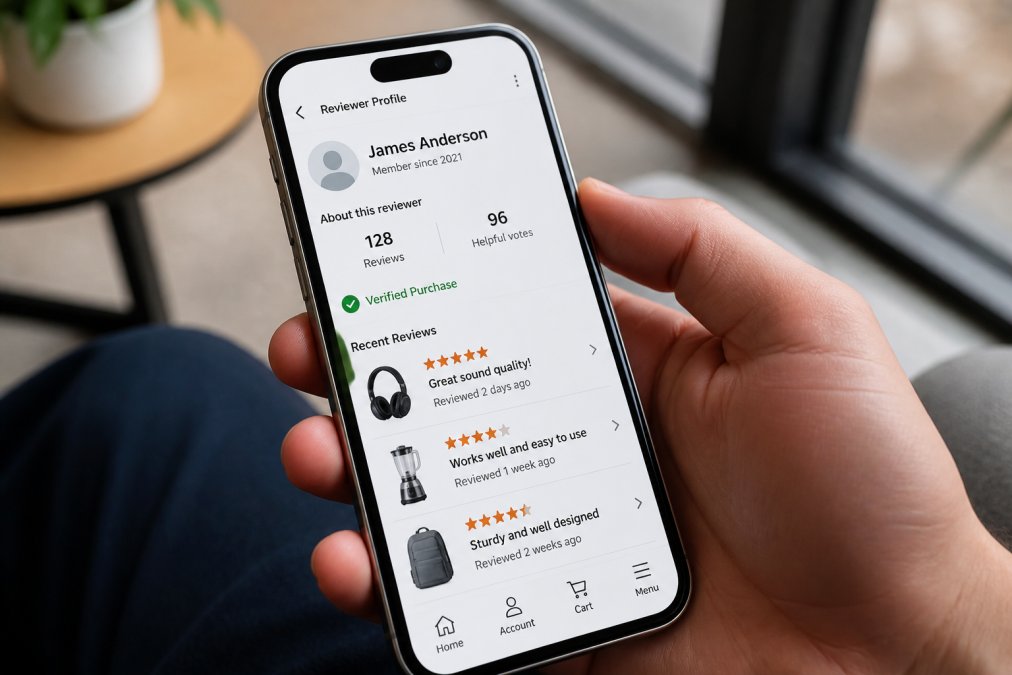
The reviewer's profile reveals whether they're a genuine customer or a bot account. Legitimate reviewers have established histories, varied purchase patterns, and authentic engagement across multiple products.
Click on the reviewer's name or profile and look for these authenticity indicators:
- Account age: New accounts created days or weeks ago that immediately post reviews are suspicious. Genuine customers typically have accounts established over months or years.
- Review history: A reviewer posting 50 reviews in one week across unrelated products is likely a paid reviewer. Real customers review products they've purchased, typically with months or years between reviews.
- Review variety: Authentic reviewers post both positive and negative reviews. A profile showing only five-star reviews for 30 different products suggests bias or incentivization.
- Content consistency: Read their other reviews. Identical phrases across different products indicate template-based fake reviews.
Verified purchase badges increase credibility but aren't foolproof, they can be gamed through bulk purchasing or review-for-payment schemes. The badge is one data point, not a guarantee.
Legitimate reviewers occasionally respond to follow-up questions or interact with other reviews (peer-reviewed research). Fake reviewers typically post and disappear. If a reviewer posted dozens of five-star reviews but never responded to a single question, that's suspicious.
Step 3: Look for Unnatural Language Patterns and Generic Content
Fake reviews often sound like they were written by someone unfamiliar with the product or using a template. Authentic customer reviews contain specific details, natural conversational language, and genuine emotion.
Read the text carefully. Authentic reviews mention specific features, use casual language, and often include minor complaints. A real customer might write: "The handle kept slipping in my sweaty hands during my workout, but the fit is otherwise perfect and it arrived two days early."
Fake reviews often contain these red flags:
- Generic praise without specifics: "This product is amazing! Highly recommend!" without explaining what makes it amazing.
- Overly formal language: Professional marketing copy instead of casual customer voice. "This product delivers exceptional value and superior performance" sounds like ad copy.
- Repetitive phrases: The same sentences appearing across multiple reviews, like "Great quality, fast shipping, highly recommend" verbatim in 15 different reviews.
- Unrelated enthusiasm: Praising a kitchen gadget for being "perfect for my home gym setup" or mentioning features the product doesn't have.
- Extreme emotional language: All-caps words, excessive exclamation marks, or hyperbolic claims without context.
Compare the review's tone to others. If 30 reviews use casual, varied language and one reads like corporate marketing copy, that one is likely fabricated. Authentic reviews sound like they came from different people with different communication styles.
Real reviewers often describe how they use the product: "I bought this for my morning commute and it fits perfectly in my backpack." Fake reviews skip contextual details and jump straight to generic praise.
Step 4: Evaluate Star Rating Distribution and Extreme Sentiment
The distribution of star ratings reveals whether feedback is balanced or manipulated. Authentic products typically show a realistic spread: mostly positive reviews with some negative and neutral ones. Fake review campaigns often create artificial extremes.
Most legitimate products have approximately this distribution:
- 60-80% five-star reviews
- 10-20% four-star reviews
- 5-10% three-star or lower reviews (the FTC)
Products with 95% five-star reviews and 5% one-star reviews (with almost nothing in between) suggest manipulation. Real customer satisfaction doesn't produce that binary distribution.
Look for unnatural clustering at extremes. If a product has 200 five-star reviews and 180 one-star reviews with only 10 reviews in the three-to-four-star range, someone is running a fake campaign. Either way, the review distribution is compromised.
Analyze sentiment in extreme reviews. Five-star reviews should mention specific benefits. One-star reviews should describe specific problems. If all one-star reviews say "terrible product, don't buy" without explaining what went wrong, they're likely fake. Similarly, if all five-star reviews use identical praise without specifics, they're likely fake.
Watch for emotionally disproportionate reviews. A kitchen towel doesn't typically inspire passionate responses. If reviews read like testimonials for a life-changing device when the product is a basic household item, the sentiment is artificial.
Step 5: Identify Incentivized Reviews and Paid Testimonials
Incentivized reviews and paid testimonials are often disclosed, but the disclosure might be buried or vague. Authentic reviews are given freely by customers sharing genuine experience. Paid reviews are written by compensated people, creating a conflict of interest.
Look for disclosure language. Federal Trade Commission guidance requires reviews to disclose material connections, paid partnerships, free products given in exchange for reviews, or affiliate relationships (the FTC). Legitimate disclosures appear prominently near the review text: "I received this product free in exchange for an honest review" or "I am an affiliate partner and earn commission from sales."
Vague or buried disclosures are red flags. If a disclosure appears in tiny text at the bottom of a 500-word review, the reviewer may be trying to obscure the financial relationship. Genuine reviewers disclose openly.
Some reviewers make a business of reviewing products in exchange for payment or free items. Their profiles often show hundreds of reviews posted rapidly across diverse categories, consistent five-star ratings, disclosure language in nearly every review, and professional product photography.
Compare incentivized reviews to organic reviews. Free reviewers mention problems, use casual language, and sometimes criticize products. Paid reviewers almost always praise enthusiastically and rarely mention downsides.
Watch for affiliate relationships. Some reviewers link to products with affiliate codes or referral links, creating a financial incentive to recommend the product. The presence of an affiliate link doesn't prove the review is fake, but it does mean the reviewer profits from your purchase.
Step 6: Use Fake Review Checker Tools for Detection
Third-party verification tools analyze reviews for patterns of manipulation and bot activity. While no tool is 100% accurate, they provide helpful verification.
Common approaches include:
- Linguistic analysis: Detecting unnatural language patterns, repetitive phrases, and template-based content
- Metadata examination: Analyzing timestamps, IP addresses, and review velocity to identify coordinated campaigns
- Sentiment analysis: Comparing emotional tone across reviews to identify artificially extreme sentiment
- Bot activity detection: Flagging accounts with suspicious posting patterns or new accounts with immediate high review volume
- Verified purchase cross-referencing: Identifying reviewers with verified badges who post identical reviews across multiple products
Use these tools as supplementary verification after manual analysis, not as a replacement. A tool might flag a review as suspicious, but your own reading might reveal it's actually authentic. A tool's finding should prompt further investigation, not serve as final judgment.
Examples of Fake Product Reviews You Should Recognize
The Template Review: "Great product! Fast shipping! Highly recommend! 5 stars!"
This appears verbatim across multiple products with no specific details about what makes it good or how the reviewer uses it. Real customers describe their experience; fake reviewers use templates.
The Competitor Sabotage Review: "This product is terrible! Don't waste your money! Complete garbage!"
This one-star review provides no details about what's wrong or how the product failed. Real negative reviews explain what went wrong.
The Fake Positive Surge: A product has 8 reviews over three months, then suddenly receives 47 five-star reviews in one week, all from new accounts with no other reviews.
This pattern indicates a paid review campaign. Legitimate products don't experience review surges from dozens of brand-new accounts simultaneously.
The Affiliate Disclosure Buried in Text: A 400-word glowing review ends with small text: "*I receive a small commission if you purchase through my link."
The disclosure exists but is hidden where most readers won't see it. Genuine reviewers disclose prominently upfront.
Spotting fake product reviews requires combining multiple verification methods. Check review dates and frequency, analyze reviewer profiles, read for unnatural language, evaluate rating distributions, identify incentivized content, and use verification tools as backup. When shopping on discount platforms like TDR Shopper, these skills protect your budget by helping you avoid products with artificially inflated ratings.
The most reliable reviews come from established accounts with purchase history, specific product details, balanced feedback, and honest language. When you see reviews matching these criteria across multiple sources, you can shop with confidence. When reviews show the patterns described above, dig deeper or consider alternative products. Your purchasing power is too valuable to waste on items hidden behind fake positive reviews or sabotaged by fake negative ones.
Frequently Asked Questions
Q: What are the most common red flags of a fake product review?
A: Fake reviews often contain generic language, extreme five-star or one-star ratings, unverified reviewer profiles with no purchase history, and timestamps showing multiple reviews posted within hours. Look for reviews that don't mention specific product details, use repetitive phrasing across multiple products, or lack verified purchase badges. Paid testimonials may explicitly mention incentives or use promotional language that feels out of place for authentic customer feedback.
Q: Can AI detect fake reviews, and should I trust AI-powered tools?
A: Yes, AI-powered fake review checker tools can identify patterns humans miss, including synthetic language, bot activity, and review velocity anomalies. However, no tool is 100% accurate. Use them as one layer of verification alongside manual inspection. Tools analyze metadata, sentiment patterns, and linguistic markers to flag suspicious reviews, but they work best when combined with your own evaluation of reviewer profiles, verified purchase badges, and product-specific feedback.
Q: How do I report fake reviews to online retailers?
A: Most major retailers have a 'Report' or 'Flag as Inappropriate' button directly on the review. Click it and select the reason (fake review, spam, or misleading content). Provide specific details about why you believe the review is inauthentic. Many platforms also allow you to contact customer service with evidence. The Federal Trade Commission (FTC) enforces rules against fake testimonials and paid endorsements; you can file complaints through their website if a retailer is knowingly hosting astroturfing campaigns.
Q: What should I do if I spot a verified purchase badge but still suspect the review is fake?
A: A verified purchase badge is helpful but not foolproof. Examine the reviewer's full history: do they post dozens of reviews daily across unrelated products? Does their language feel robotic or copied? Check if the review contains specific product details or just generic praise. Compare their review to others on the same product. If the account is new, has no other reviews, or the feedback contradicts the product's actual specifications, the purchase badge alone doesn't guarantee authenticity. Use multiple verification methods together.
This article was written using GrandRanker