

Ways to Save on Household Essentials 2026
Table of Contents
- How to Create a Household Budget 2026
- Ways to Save on Household Essentials Through Meal Planning
- Bulk Buying Strategies for Families
- Energy Efficiency and Utility Cost Reduction
- DIY Cleaning Supplies and Household Maintenance
- Subscription Audit, Insurance Review, and Debt Refinancing
- Best Discount Sites for Home Goods in 2026
- Ways to Save on Household Essentials: The Psychology of Spending
Last Updated: August 16, 2026
How to Create a Household Budget 2026
A household budget allocates your income toward fixed expenses, variable spending, savings, and debt repayment. The biggest obstacle to cost-cutting isn't income, it's the absence of a plan. Without a budget, discretionary spending fills every gap, and most families cannot tell you where the money went. Building a functional household budget takes about two hours.
Track Discretionary Spending First
Most budgeting guides start with fixed expenses, which is backwards. Fixed expenses like rent and insurance are already locked in. Discretionary spending is where cash flow bleeds out and where you have immediate control. Pull your last 60 days of bank and credit card statements. Categorize every transaction that wasn't a fixed bill: groceries, dining out, subscriptions, household supplies, entertainment, impulse purchases.
That total is your baseline, and it's the number you're working to reduce.
Paycheck Allocation and Automatic Savings
Once you know your discretionary baseline, set up automatic savings before you spend anything else. According to Consumer Financial Protection Bureau guidance on savings automation, automating transfers on payday removes the decision entirely, and that removal is the point.
A practical allocation framework for 2026:
| Category | Suggested Allocation | Notes |
|---|---|---|
| Housing + utilities | 30-35% of take-home | Adjust for your market |
| Groceries + household | 10-15% | Track unit pricing |
| Savings + emergency fund | 10-20% | Automate on payday |
| Debt repayment | 5-15% | Prioritize high-interest |
| Discretionary | Remainder | Review monthly |
Paycheck allocation only works when savings move automatically. If it stays in checking, it gets spent.
Ways to Save on Household Essentials Through Meal Planning
Meal planning attacks two costs simultaneously: food waste and impulse grocery purchases. Families who plan meals before shopping consistently spend less per week and throw away significantly less food.

Pick seven dinners on Sunday. Build your shopping list from those dinners, plus breakfasts and lunches using overlapping ingredients. Shop once and stick to the list.
Unit Pricing and Leftover Use
Unit pricing is the most underused grocery skill. The shelf price tells you almost nothing; the price per ounce, pound, or count determines value. Most grocery stores display unit pricing on shelf tags, but shoppers routinely ignore it. A larger package isn't always cheaper per unit, and store brands are frequently identical in quality to name brands at lower unit price.
Leftover use compounds savings. A roast chicken on Monday becomes tacos Tuesday and soup Wednesday. Planning for leftovers means buying one protein and extracting three meals from it.
Inflation-Adjusted Grocery Shopping Strategies
Grocery prices in 2026 remain elevated compared to pre-2022 baselines. Simply buying generic brands is no longer sufficient. Inflation-adjusted shopping requires a more active approach:
- Track prices on your top 20 most-purchased items across at least two stores
- Stock up on non-perishables when prices dip below your tracked average
- Shift protein sources seasonally; eggs, legumes, and canned fish offer strong nutritional value at lower cost
- Use store loyalty apps for digital coupons on items already on your list
- Avoid "loss leader" traps where stores discount one item to recoup on everything else
The USDA Economic Research Service food price outlook tracks food-at-home price trends and is worth bookmarking when planning your monthly grocery budget.
Bulk Buying Strategies for Families
Bulk purchasing reduces cost-per-unit, but only when you actually use what you buy. The mistake is treating bulk buying as universally smart, it isn't. Buying 96 rolls of paper towels makes sense. Buying 10 pounds of fresh strawberries does not.
What to Buy in Bulk and What to Skip
Buy in bulk:
- Non-perishable pantry staples: rice, pasta, oats, canned goods, dried beans
- Cleaning supplies: dish soap, laundry detergent, all-purpose cleaner
- Paper products: toilet paper, paper towels, trash bags
- Personal care items with long shelf lives: shampoo, toothpaste, soap
Skip bulk buying for:
- Fresh produce (spoilage eliminates savings)
- Items you haven't tried before
- Products with short shelf lives or specific storage requirements
- Anything you already have adequate stock of
Bulk buying pairs well with discount shopping. TDR Shopper carries a curated selection of household and kitchen essentials at 50% off, making it practical for stocking up on bulk items without paying full retail.
Energy Efficiency and Utility Cost Reduction
Energy efficiency is one of the most durable ways to reduce household costs because savings recur every month.
Thermostat Management and Appliance Habits
The U.S. Department of Energy recommends setting your thermostat to 68°F while home in winter and lower when asleep or away. Each degree of adjustment translates to measurable savings. A programmable or smart thermostat automates this without daily discipline.
Appliance habits matter equally:
- Run dishwashers and washing machines during off-peak hours
- Switch to cold-water washing; modern detergents work at lower temperatures
- Clean dryer lint traps before every cycle
- Unplug devices that draw standby power when not in use
- Replace incandescent bulbs with LED alternatives
According to U.S. Department of Energy home energy efficiency guidance, heating and cooling account for nearly half of typical home energy use, making thermostat habits the highest-impact single change most families can make.
DIY Cleaning Supplies and Household Maintenance
The cleaning products aisle is aggressively marketed with dozens of specialized products, each solving a problem that basic ingredients could handle at a fraction of the cost.
A functional DIY cleaning kit requires:
- White vinegar: cuts grease, deodorizes, and disinfects
- Baking soda: abrasive cleaner for sinks, tubs, and stovetops
- Castile soap: biodegradable, effective for floors and dishes
- Water: carrier for cleaning solutions
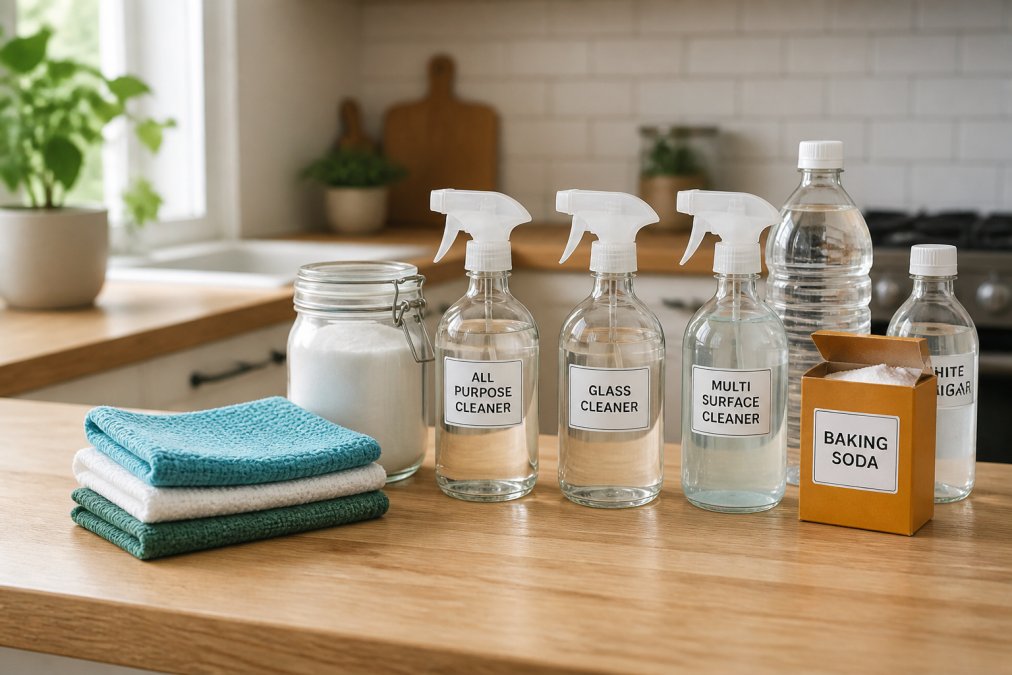
A basic all-purpose spray is one part white vinegar to one part water with a few drops of castile soap. Reusable cleaning cloths replace paper towels and reduce ongoing cost.
For household maintenance, address small issues before they become expensive repairs. A dripping faucet washer costs almost nothing to replace. Caulking around tubs and windows annually prevents water damage. Changing HVAC filters on schedule maintains efficiency and extends equipment life.
Subscription Audit, Insurance Review, and Debt Refinancing
These three categories share a common trait: they're set-and-forget expenses that quietly drain budgets for months or years.
Subscription audit: Pull every recurring charge from your statements. List each service, its monthly cost, and when you last used it. Cancel anything unused in 30 days. Pause seasonal services. Negotiate rates on services you keep; many will offer reduced rates rather than lose customers.
Insurance audit: Review auto, home, and life insurance policies annually. Compare rates from at least three providers. Ask your current insurer about discounts for bundling, safe driver records, or home security systems. The National Association of Insurance Commissioners consumer resources provides state-specific guidance on comparing policies.
Debt refinancing: High-interest debt is expensive. If your credit score has improved, refinancing may reduce your interest rate. Even modest reductions on significant balances produce meaningful cash flow improvement over 12-24 months.
Combining all three can find $200-400 per month in existing expenses without lifestyle changes.
Best Discount Sites for Home Goods in 2026
Finding reliable discount sites requires discernment. The question isn't whether a site offers lower prices, most do. The question is whether products are worth buying at any price.
What Makes a Discount Site Worth Your Time
A discount site earns attention when it meets three criteria: transparent product quality, a clear return policy, and a curated selection rather than overwhelming clearance catalogs.
TDR Shopper is built around this model. Every item is offered at 50% off across a curated selection of household essentials, kitchen products, and home improvement items. The inventory is deliberately selected, not random overstock. For busy families needing quality household products without sorting through endless listings, that curation is valuable.
What to look for when evaluating any discount site:
- Clear return policy: If returns are difficult or expensive, the discount is partially illusory
- Product descriptions with real specifications: Vague listings hide quality problems
- Customer reviews on individual products: Not just site-level ratings
- Recognizable product categories: The same categories you'd buy at full price, just cheaper
The most effective ways to save on household essentials combine a reliable discount platform with meal planning and bulk buying strategies, not relying on any single approach.
Ways to Save on Household Essentials: The Psychology of Spending
Most cost-cutting guides treat overspending as a math problem. It's a behavior problem. Retail environments are engineered to trigger unplanned purchases through scarcity cues, social proof, frictionless checkout, and personalized recommendations.
Recognizing these mechanisms neutralizes them. Practical countermeasures:
- Implement a 24-hour rule for unplanned purchases over a threshold; many impulse buys don't survive overnight
- Shop with a list and a limit, knowing your maximum spend before shopping changes decision-making
- Unsubscribe from promotional emails; exposure to deals creates desire for things you didn't know you wanted
- Track your wins, recording weekly savings against your baseline creates positive reinforcement
Financial literacy research shows awareness of spending triggers, not willpower alone, drives lasting behavior change. According to NBER research on consumer spending behavior and self-control, the most effective cost-cutting interventions work by changing the environment rather than demanding more self-discipline.
The ways to save that families actually stick with reduce friction on right behaviors and increase friction on wrong ones. Automation, meal planning, subscription audits, and curated shopping work because they change the default, not because they require heroic discipline daily.
| Strategy | Effort Level | Time to First Savings | Recurring Benefit |
|---|---|---|---|
| Subscription audit | Low | Immediate | Monthly |
| Meal planning | Medium | First week | Weekly |
| Thermostat management | Low | First billing cycle | Monthly |
| DIY cleaning supplies | Low | First purchase | Ongoing |
| Bulk buying | Medium | First shop | Per-purchase |
| Debt refinancing | High | 30-60 days | Monthly |
| Insurance review | Medium | 30 days | Annual |
| Discount site shopping | Low | Immediate | Per-purchase |
Families who consistently spend less aren't necessarily earning more. They've built systems that make the right choice the easy choice and revisit those systems regularly rather than setting and forgetting.
Frequently Asked Questions
What are the most effective ways to save on household essentials in 2026?
The highest-impact moves are meal planning with a weekly grocery list, auditing subscriptions you no longer use, switching to DIY cleaning supplies, and buying non-perishables in bulk. Pairing those habits with a simple household budget that tracks discretionary spending gives you a clear picture of where money is leaking. Shopping through curated discount platforms that offer consistent markdowns on quality household goods also adds up quickly across a full year.
What is the $27.40 rule for household budgeting?
The $27.40 rule is a savings framework built on the idea that setting aside $27.40 each day adds up to roughly $10,000 over a year. Applied to household budgeting, it encourages families to find small daily cost reductions, skipping a convenience purchase here, choosing a store brand there, rather than making one dramatic lifestyle cut. The consistency of the habit matters more than the size of any single saving.
What are the best bulk buying strategies for families?
Focus bulk purchases on items with long shelf lives: paper products, canned goods, laundry detergent, and cleaning supplies. Compare unit pricing rather than package price to confirm you're actually saving. Avoid bulk buying perishables unless your household can realistically consume them before spoilage. Splitting bulk orders with a neighbor or another family stretches the savings further without requiring extra storage space. Track what you actually use monthly so you don't overbuy.
How can I reduce monthly recurring household expenses?
Start with a subscription audit, list every recurring charge on your bank and credit card statements and cancel anything unused. Then review your utility bills: adjusting your thermostat by just a few degrees and switching to LED lighting reduces energy costs noticeably. Call your insurance providers annually to ask about current rates; loyalty rarely gets you the best deal. Refinancing high-interest debt into a lower-rate product frees up cash flow each month without cutting a single purchase.
Are discount sites for home goods worth it, or do they sell low-quality products?
Quality varies widely across discount platforms. The most reliable ones sell name-brand or verified-quality products at reduced prices due to overstock, seasonal clearance, or direct sourcing, not because the goods are inferior. Before buying, check whether the site lists recognizable brands, provides product details, and has a clear return policy. A genuine 50% discount on a quality item beats a 10% discount on a name brand at full retail every time.
How do I build an emergency fund while still cutting household costs?
Automate a fixed transfer to a separate savings account on payday, even $25 to $50 per paycheck builds a buffer without requiring willpower. Treat the emergency fund contribution like a non-negotiable bill. As your cost-cutting habits reduce grocery, utility, and subscription spending, redirect a portion of those savings directly into the fund rather than absorbing them back into discretionary spending. Most financial planners recommend three to six months of essential expenses as the target.
Managing household costs in 2026 requires more than good intentions, it requires a system. TDR Shopper gives budget-conscious families a direct advantage: a curated selection of household and kitchen essentials at 50% off, so the products you need most cost half what you'd pay elsewhere. Browse the full selection and add to cart today to start putting these savings strategies into practice immediately.
This article was written using GrandRanker